Column
media

media
column
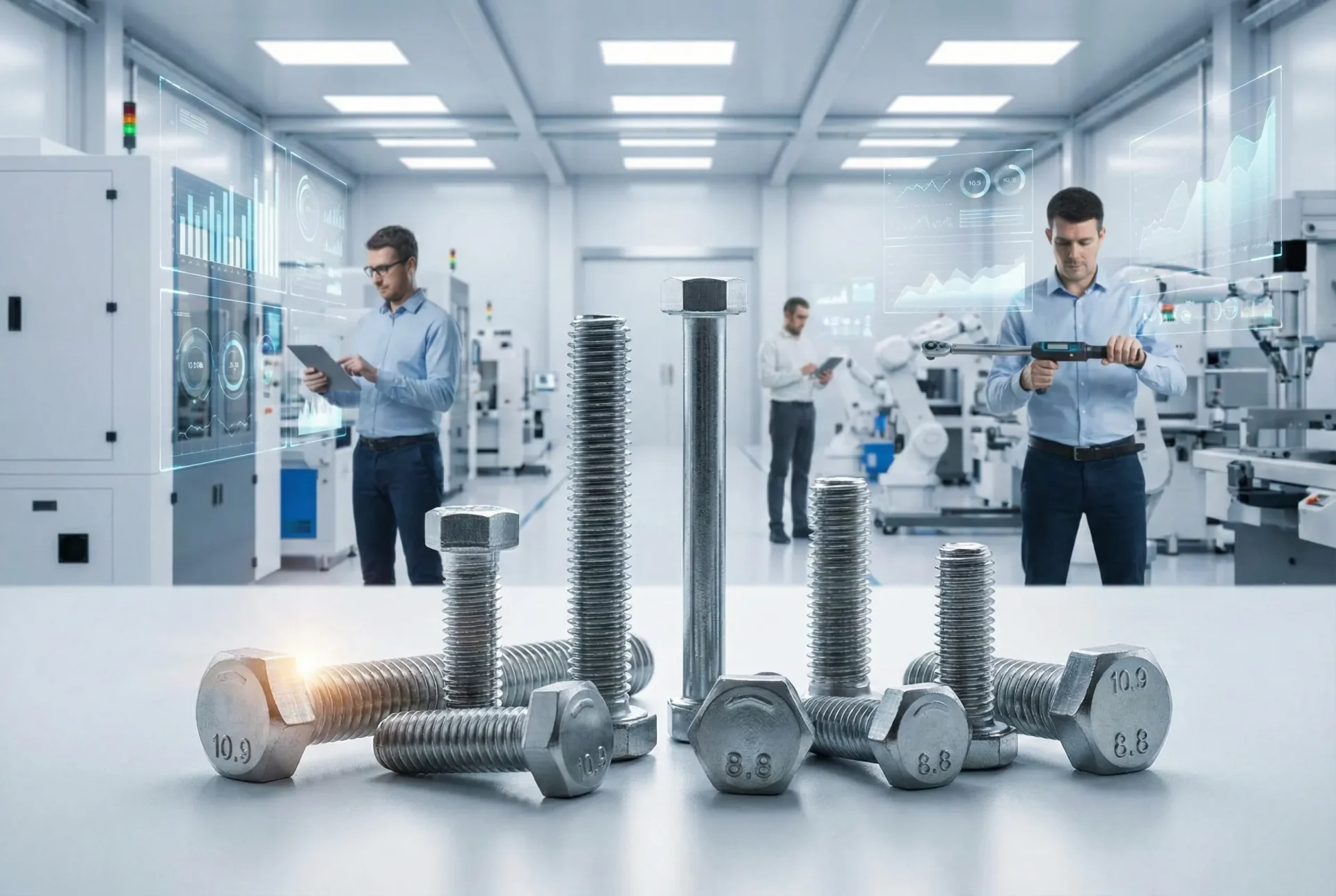
On a manufacturing floor, the failure of a single “screw” can destroy the reliability of an entire product and, in some cases, lead to catastrophic accidents. Especially for industrial machinery with high vibration or infrastructure equipment used in harsh environments, selecting the appropriate “Strength Class” is a top priority in design and procurement.
In this article, we provide a comprehensive guide for manufacturing executives, procurement managers, and on-site engineers, covering everything from the basics of screw strength classes to essential calculation formulas and the increasingly popular IoT-driven fastening quality management. Furthermore, we will touch upon the procurement environment in Vietnam, where industrialization is rapidly progressing, and introduce how Ohta Vietnam’s solutions balance cost optimization with quality assurance. We hope this article serves as a guide for safe and efficient fastening design.
Numbers such as “4.8” or “10.9” marked on screw heads or packaging represent the “Strength Class.” These numbers serve as a global language indicating how much load the screw can withstand.
For example, in the notation “10.9,” the first number “10” indicates the Nominal Tensile Strength, meaning it can withstand up to 1,000 N/mm². The following “.9” indicates that the Yield Point (or proof stress) is 90% of the tensile strength. In other words, if a load of 900 N/mm² or more is applied, the screw will undergo “permanent deformation” and will not return to its original shape. Fastening with over-specified parts without this knowledge leads to increased costs, while under-specified parts significantly increase the risk of breakage.
While the Japanese Industrial Standards (JIS) are widely referenced in many manufacturing sites today, most are compliant with the international standard ISO 898-1. In today’s world of global supply chains, understanding these international standards is essential.
Particularly when procuring parts from overseas hubs like Vietnam, verifying that quality control is based on JIS or ISO—rather than just local standards—is the key to maintaining “Japanese Quality.” At Ohta Vietnam, we handle only products that strictly comply with these international standards, accurately bringing Japanese design intent to life.
The most important factor in screw selection is controlling the “axial force” (the clamping force). To achieve proper fastening, the following basic formula is used:
$$T = K \cdot d \cdot F$$
Here, $T$ represents the tightening torque (N·m), $K$ is the torque coefficient, $d$ is the nominal diameter of the screw (mm), and $F$ is the axial force (N). Since the torque coefficient $K$ varies greatly depending on the lubrication state of the screw surface and the material, the management of this coefficient becomes more critical as the strength class of the screw increases.
In recent years, Ohta Vietnam has been focusing on Smart Factory implementation using IoT. While conventional quality control mainly relied on torque checks via sampling inspections, the introduction of IoT-compatible digital torque wrenches allows for the real-time collection and analysis of all fastening work data.
This ensures traceability regarding “who tightened it, when, and with how much force,” providing digital proof that optimal fastening has been performed based on the strength class. This offers a powerful competitive advantage, especially in sectors requiring high safety, such as automotive and precision equipment.
Key Data: Statistics on Screw/Fastener Market and Quality
The biggest concern for Japanese companies procuring in Vietnam is “quality variance.” Even when a product claims a strength class of “8.8,” there are cases where it fails to perform to standard due to improper heat treatment or material impurities.
At Ohta Vietnam, we regularly conduct quality audits based on Japanese standards for our partner factories. We verify quantitative data such as hardness tests, tensile tests, and salt spray tests in-house to validate the strength class before delivery. This allows us to ensure safety equivalent to Japanese domestic production while achieving cost reductions through local procurement.
To ensure proper screw selection and stable procurement, we recommend checking the following items:
A screw’s strength class is not just a numerical material property; it is the “foundation of design” that supports product safety and corporate trust. By correctly understanding the relationship between tensile strength and yield point and combining proper calculations with IoT-driven quality control, productivity on the manufacturing floor can be dramatically improved.
In a dynamically changing market like Vietnam, choosing a reliable partner is a vital strategy for winning in global competition. Ohta Vietnam utilizes its years of expertise in fastening technology, the latest digital tools, and a strong local network to support your manufacturing from the ground up. If you are unsure which strength class to select or wish to establish a stable procurement route in Vietnam, please feel free to consult Ohta Vietnam.
For inquiries regarding samples or materials, please respond to this email or contact our sales representative!
At Ohta Vietnam, we not only provide ready-made products such as screws and bolts, but also support activities in the manufacturing field such as cutting, inspection, assembly, packaging…
Our equipment list is here
As a “specialized support” for the manufacturing industry in Asia. If you have any related questions, feel free to contact Ohta Vietnam for detailed support!
URL: https://ohtavn.com/en/contact/