Column
media

media
column
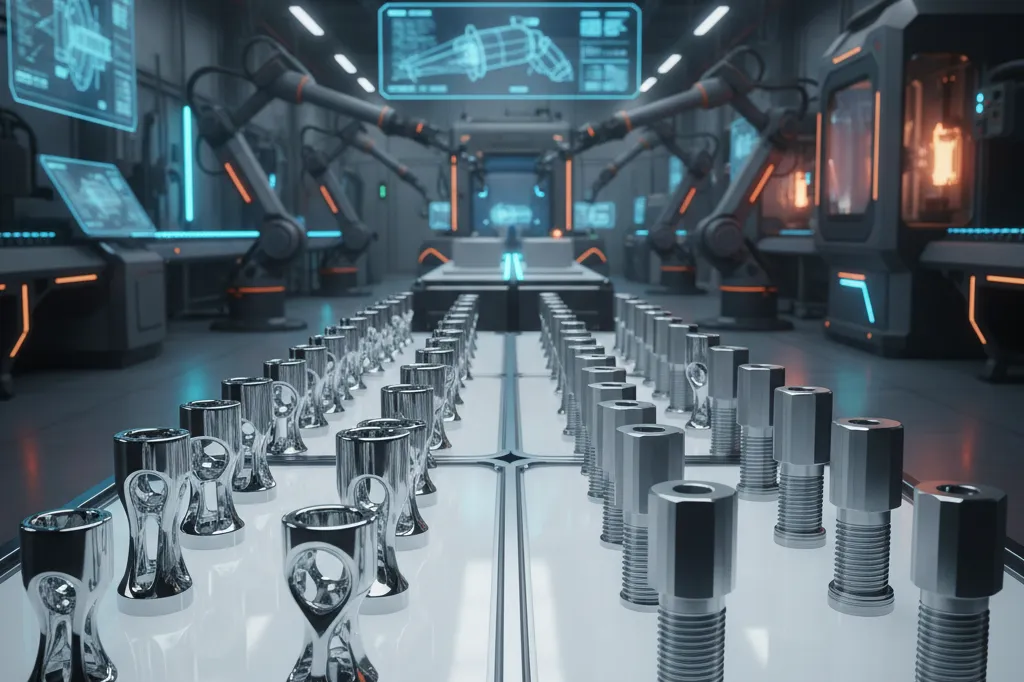
The manufacturing sector faces unprecedented challenges: meeting high-mix, low-volume (HMLV) demand, shortening lead times, and strengthening supply chains. In particular, the procurement of fasteners (screws, bolts, and nuts), which form the backbone of a product, often becomes a bottleneck for efficiency due to its complexity. This article details the potential of 3D printing (Additive Manufacturing, AM)—a breakthrough technology attracting significant attention—to revolutionize the future of traditional screw manufacturing.
In Vietnam’s manufacturing industry, 3D printing technology is strategically positioned by the government, and its application is highly anticipated. However, in the realm of fasteners, where high precision is required, conventional cutting processes remain dominant. This report will thoroughly analyze the latest trends in 3D printing technology, particularly the benefits (design freedom, shorter prototyping) and current technical challenges (precision, cost, mass production) that metal 3D printing brings to screw manufacturing, based on specific quantitative data. We aim to provide the executives and procurement managers of Japanese manufacturers—our readers—with practical knowledge and a roadmap for integrating this innovative technology into their procurement strategies.
3D printing is growing rapidly as a core technology supporting the Digital Transformation (DX) of the manufacturing industry. The global market size for metal 3D printing was estimated at $2.478 billion in 2024 and is projected to reach $10.893 billion by 2032, exhibiting a Compound Annual Growth Rate (CAGR) of 20.3%. The Japanese market, in particular, is expected to reach $8.2 billion by 2033, with a CAGR of 19.1% between 2025 and 2033. This growth is driven by the expanded adoption in high-value-added sectors such as aerospace, medical, and automotive.
Key Data: Global 3D Printing Market Forecasts
Traditional screw manufacturing relies mainly on processes like cutting and cold forging, which require molds and dedicated tools, posing challenges in terms of initial investment and lead time. In contrast, 3D printing is increasingly being applied in the following areas:
In Vietnam, 3D printing is positioned by the government as part of the “New Material Technology” and “Manufacturing/Automation Technology” groups in its science and technology innovation development strategy (until 2030), promoting the development of legal frameworks and human resources.
3D printing technology, particularly methods like Metal Powder Bed Fusion (PBF), enables the fabrication of parts with complex internal structures that are impossible with traditional processes. This allows for the integration of lattice structures for weight reduction directly into the fastener or the consolidation of functions from multiple parts into a single component (reducing assembly count).
For example, custom bolts with specific vibration-damping features or fastening elements with tiny cavities for sensor integration can be designed, contributing to the overall performance improvement of the product.
The demand for high-mix, low-volume (HMLV) sourcing is a focus area for suppliers like OHTA VIETNAM, and 3D printing accelerates this trend. Since no molds are required, the process can significantly reduce the development period for manufacturing special-order screws and prototypes compared to conventional methods.
This process allows for rapid response to customer-specific needs and shortens the Time-to-Market. 3D printing is a key to partially resolving the drawbacks of HMLV production, such as increased production costs and extended lead times.
3D printing is an Additive Manufacturing (AM) process that builds parts layer by layer, using only the necessary material. This results in minimal material waste (chips) compared to cutting processes. This material efficiency translates directly into cost savings, especially when using expensive special alloys (like titanium alloys) or in the manufacturing of custom components.
The core function of a fastener relies on securing thread accuracy and tightening torque. However, current 3D printing technology presents the following challenges:
【Solution】: The most realistic solution is hybrid manufacturing, where the near-net shape is created via 3D printing, and only the thread sections are finished with high-precision cutting. This approach balances design freedom with strict dimensional requirements.
Fasteners require high mechanical strength, including tensile strength, shear strength, and fatigue strength. The strength of a 3D-printed metal part can differ from that of traditionally forged or cut parts, depending on the build conditions and the presence of internal porosity.
【Solution】: It is essential to apply the quality control expertise of the parent company (OHTA Co., Ltd.)—based on ISO 9001 and ISO 14001—to the Vietnam operation.
This involves providing Non-Destructive Inspection (NDI) after fabrication and an inspection proxy service using the company’s in-house inspection equipment to meet customer quality demands. Specifically, horizontally deploying the quality management processes for 3D-printed parts developed in the aerospace and medical fields is crucial.
Manufacturing in Vietnam is advancing technologically, primarily driven by foreign companies, but faces challenges in localizing supply chains and moving towards higher value-added production. 3D printing is well-suited to the Vietnamese market in the following ways:
However, there have been cases where large 3D printer investment projects in Vietnam stalled, citing challenges such as rising material costs and difficulty securing R&D personnel.
OHTA VIETNAM has two core pillars: in-house manufacturing of precision machined parts and wholesale of fasteners, supplemented by supplying MRO materials as an authorized TRUSCO distributor. Integrating 3D printing into this business structure allows the company to offer customers a “Hybrid Solution” in the following ways:
This strategy further strengthens the company’s greatest advantage—its flexible response to high-mix, low-volume procurement needs—solidifying its position as a manufacturing partner, rather than just a parts supplier.
3D printing technology holds the potential to bring irreversible changes to the procurement and production processes of fasteners in the manufacturing industry. While conventional cutting and forging currently maintain an advantage in high-precision threading and cost efficiency for mass production, 3D printing shows overwhelming superiority in design freedom, lead time reduction, and HMLV custom response.
Especially for Japanese manufacturers operating in Vietnam, the hybrid manufacturing strategy promoted by OHTA VIETNAM is key to simultaneously solving the dual challenges of quality and delivery time. The approach of quickly providing prototypes, urgent parts, and jigs via 3D printing, followed by high-precision mass production using cutting or the parent company’s extensive network, is both realistic and strategic.
The future of screw manufacturing is not an either/or choice between cutting and 3D printing, but rather the pursuit of the optimal solution by combining the strengths of both. We strongly recommend that your R&D and procurement departments incorporate 3D printing technology, which requires no expensive molds and generates parts solely from data, as a crucial strategic tool for mitigating supply chain risks and accelerating product development. OHTA VIETNAM is fully prepared to meet these new-era procurement needs.
For inquiries regarding samples or materials, please respond to this email or contact our sales representative!
At Ohta Vietnam, we not only provide ready-made products such as screws and bolts, but also support activities in the manufacturing field such as cutting, inspection, assembly, packaging…
Our equipment list is here
As a “specialized support” for the manufacturing industry in Asia. If you have any related questions, feel free to contact Ohta Vietnam for detailed support!
URL: https://ohtavn.com/en/contact/