Column
media

media
column
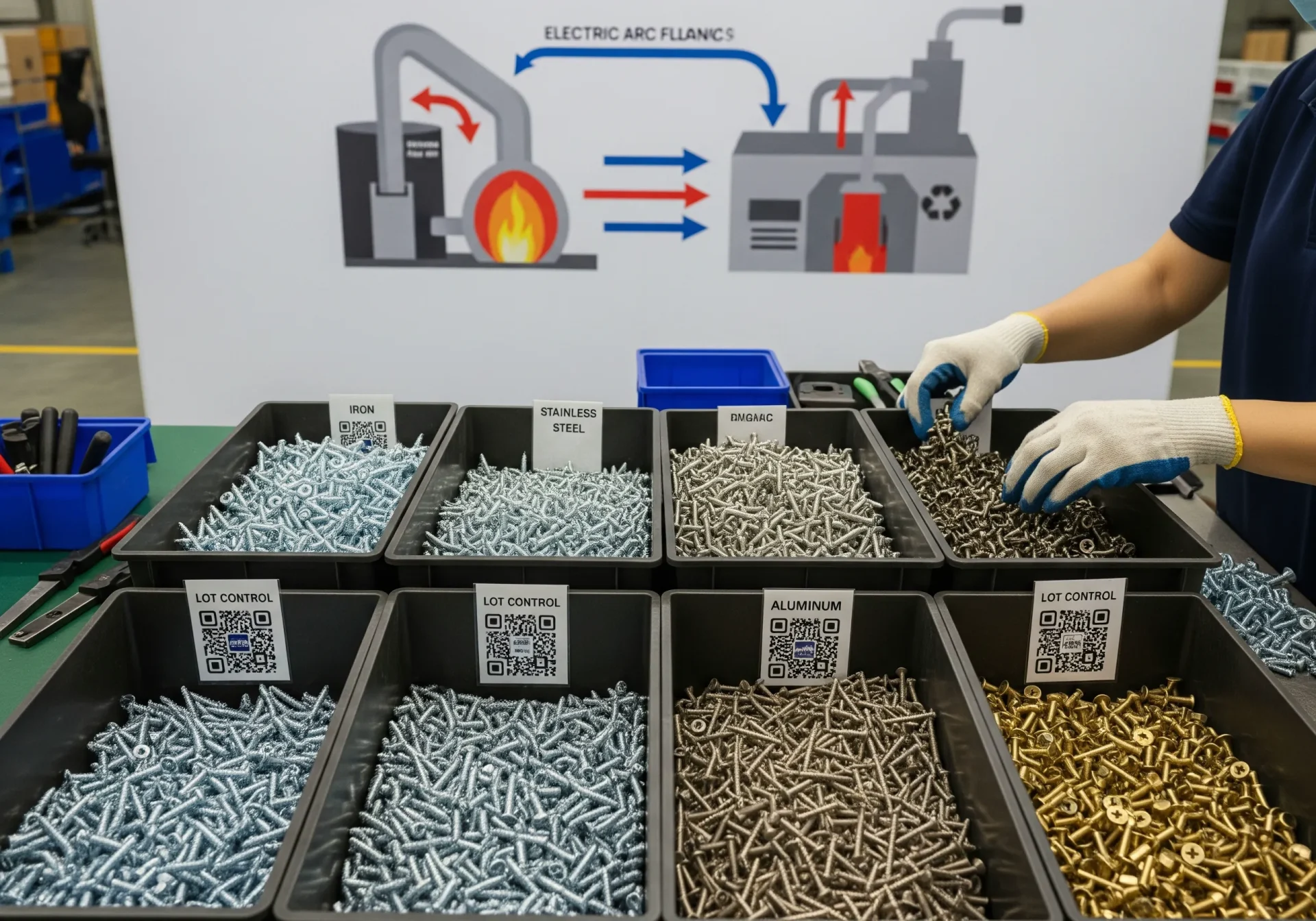
Achieving carbon neutrality and transitioning to a circular economy begins with the design and operation of individual components. Screws (bolts, nuts, machine screws) are numerous and are typical components that often become “high-mix, low-volume” or “mixed materials” on-site. This article explains how to put “screw recycling” into practice, from material selection to sorting/recovery and standards/certification, assuming implementation at a manufacturing site in Vietnam.
This is intended for personnel in purchasing, production engineering, quality assurance, and environment (sustainability) departments. Based on support case studies and standardization templates from Ohta VIETNAM, we will emphasize the following:
By the time you finish reading, you will have gained practical know-how that you can immediately apply on-site, from preventing the devaluation of scrap due to mixed materials to criteria for reusability and rules for notation in drawings and BOMs.
Although small, screws come in large quantities and varieties, making them components that easily become “high-mix, low-volume” or “mixed materials” on-site. To establish a circular design, it is crucial to simultaneously design and standardize four points: ① ease of material recycling, ② ease of sorting based on the presence of surface treatments or inserts, ③ material and lot traceability, and ④ on-site recovery operations (sorting, storage, handover).
30-Second Recovery Flow (Standard Proposal)
Key Points by Material (Summary)
On-site Tip: Scrap is handled in categories such as screw scrap, fastener scrap, nut scrap, and bolt scrap. Mixing materials directly leads to a lower purchase price, so make it a habit to first sort iron, stainless steel, brass, and aluminum.
Drawing the Line with Reuse Screws for critical applications (safety, pressure, high-temperature, rotating bodies, structural) are prohibited from reuse in principle. Consider reuse only for non-critical applications and only if all the following conditions are met:
Iron/Carbon Steel Screws (Zinc-plated, Black Oxide, etc.)
Features:
Easy to separate in the first stage due to magnetism and can be smoothly integrated into existing steelmaking processes. EAFs can accept a high ratio of scrap input.
Key Points for Recycling:
Remove plating such as zinc and nickel, cutting oils, and thread-locking agents as much as possible before recovery. Excessive contamination affects yield and occupational safety and health.
Design Memos:
Stainless Steel Screws (A2/A4, etc.)
Features:
Combines corrosion resistance with circularity. Easy to sort and trace with ISO 3506 material code + strength class (e.g., A2-70, A4-80) or head markings.
Caution:
Cold working or material variations can cause it to become weakly magnetic, leading to misidentification if relying solely on magnets. Use a combination of labels, markings, and incoming inspections.
Design Memos:
Aluminum Screws
Features:
Lightweight and corrosion-resistant, with a low energy load during recycling, making it advantageous for CO₂ reduction.
Operational Tips:
High-efficiency non-ferrous sorting with ECS. Store turnings dry and reduce oil content to increase their value.
Design Memos:
Brass (Copper Alloy) Screws
Features:
Can be repeatedly recycled with little degradation of physical properties. The scrap value is relatively high.
Operational Tips:
Mixing with iron directly leads to a lower unit price. Aim for zero contamination with dedicated boxes and on-site training. Recover turnings after draining liquids.
Design Memos:
Titanium Screws (Limited Applications)
Features:
A high-value-added material with high specific strength and excellent corrosion resistance; its recovery value is also high.
Caution:
Tends to be downcycled from a quality maintenance perspective. High-grade closed-loop remelting requires strict foreign material management and a dedicated route.
Operational Tips:
Completely separate from iron and stainless steel and recover separately, even in small quantities.
Resin/Plastic Screws (PA, POM, etc.)
Features:
Offers significant functional benefits like being lightweight and insulating, but mechanical recycling requires high-purity sorting as a prerequisite.
Caution:
The presence of metal inserts, glass fibers, and fillers is a barrier. Label with the resin code (e.g., PA6, PA66, POM) and separate inserts before recovery.
Operational Tips:
Pre-sort by color and material. For items with a significant thermal history, consider energy recovery as an option instead of forcing recycling.
To “systematize” circularity on-site, it is crucial to design the entire business flow from procurement and design to manufacturing, quality, recovery, and recycling, and to document who does what, when, and by what criteria. The following is the recommended approach by OHTA VIETNAM, assuming implementation in a mass-production factory in Vietnam.
Procurement and Design Stage
1) Establish a Material Policy: Set iron, stainless steel, aluminum, and brass as standard materials and clarify the priority for each product. Suppress the use of mixed materials (different materials, different platings) as much as possible, as they increase process load and reduce recovery value.
2) Drawing and BOM Notation Rules: Use a unified notation to specify the material (e.g., SUS304/A2-70, C3604, A5052), surface treatment (e.g., Cr³⁺ Trivalent Chromate, Black Oxide, No Plating), strength class, and screw standard (e.g., ISO thread/pitch) in drawings, BOMs, and labels. For small-diameter items where marking the product is difficult, state the ISO 3506 notation on the bag and box labels.
3) Evidence (Traceability): Use EN 10204 3.1 mill sheets as a basis and assign a lot ID via QR code for each incoming lot. Link the history by scanning the lot ID at each point in the process, during shipment, and upon recovery.
4) Prepare Environmental Information: Prepare self-declaration templates for recycled content based on ISO 14021 and LCA calculation sheets based on ISO 14044 in advance to be ready to respond to quotes and customer submissions.
5) Incorporate into Procurement Conditions: Add clauses to purchase agreements such as “Prior approval required for changes in material or surface treatment,” “Mill sheet submission mandatory,” “Labeling requirements,” and “Scrap recovery plan.”
Manufacturing and Quality Stage
1) Fastening Quality and Reuse Decisions: Reuse is prohibited in principle for critical applications such as safety, pressure, high-temperature, rotating bodies, and structural components. Even for non-critical applications, check for visual abnormalities, thread damage, corrosion, and thermal history. When in doubt, replace with a new part.
2) Design a Recovery Flow: Install material-specific boxes (Iron / Stainless / Brass / Aluminum / Mixed) at the end of each line and specify “when to put items in” in the work procedure manual. Manage transport using a kanban system with time tracking, and define responsibilities for full boxes, collection, weighing, and cleaning with a RACI chart.
3) Sorting and Pre-treatment: In the first stage, separate ferrous materials with magnetic separation. In the second stage, extract aluminum and copper-based materials with eddy current separation (ECS). Remove oils, chips, and locking agents as much as possible, and set a KPI for the liquid content ratio.
4) Management of Chemical Substances and Surface Treatments: Dispose of waste liquids and sludge from plating, acid washing, and degreasing processes in accordance with laws and internal regulations. Avoid excessive use of adhesives and sealants, and prioritize alternatives that can be washed off.
5) KPIs and Visualization: Publicly release monthly data on recovery rate (= recovered weight / input weight), purity (material contamination rate), yield, scrap sales price, recycled material usage rate, and CO₂ reduction amount. Visualize this data with a color-coded dashboard for each line.
Vietnam Procurement × Ohta Screw Solutions (Example)
1) Implementation Steps (4-Week Model):
2) Service Menu:
We provide end-to-end support, including material standardization (A2/A4, trivalent chromate, no plating, etc.), traceability design (EN 10204 3.1 + QR), milk-run recovery operation design, creation of LCA and environmental self-declaration forms, and attendance at audits.
3) Mini Cost-Benefit Analysis (Example):
4) Common Pitfalls:
Unlabeled small bags, “just mix it for now” on-site habits, failure to update labels during equipment relocation, price reductions due to high oil content, and mixing stainless steel with iron by relying only on magnetic separation—all of these directly lead to lower unit prices and yields.
5) Checklist (Excerpt):
This article has outlined the key points for implementing “screw recycling” on-site, focusing on iron, stainless steel, aluminum, and brass. This is achieved by unifying surface treatments and standards, designing for easy sorting, and establishing evidence trails. Reuse for critical applications should be avoided, while yield and value are increased through material-specific recovery → magnetic separation → eddy current separation. By preparing the rationale with standards like EN 10204 3.1 and ISO 14021/14044, it is possible to achieve both cost reduction and circularity goals, even in high-mix, low-volume production in Vietnam, by using Ohta’s procurement and recovery schemes.
For inquiries regarding samples or materials, please respond to this email or contact our sales representative!
At Ohta Vietnam, we not only provide ready-made products such as screws and bolts, but also support activities in the manufacturing field such as cutting, inspection, assembly, packaging…
Our equipment list is here
As a “specialized support” for the manufacturing industry in Asia. If you have any related questions, feel free to contact Ohta Vietnam for detailed support!
URL: https://ohtavn.com/en/contact/