Column
media

media
column
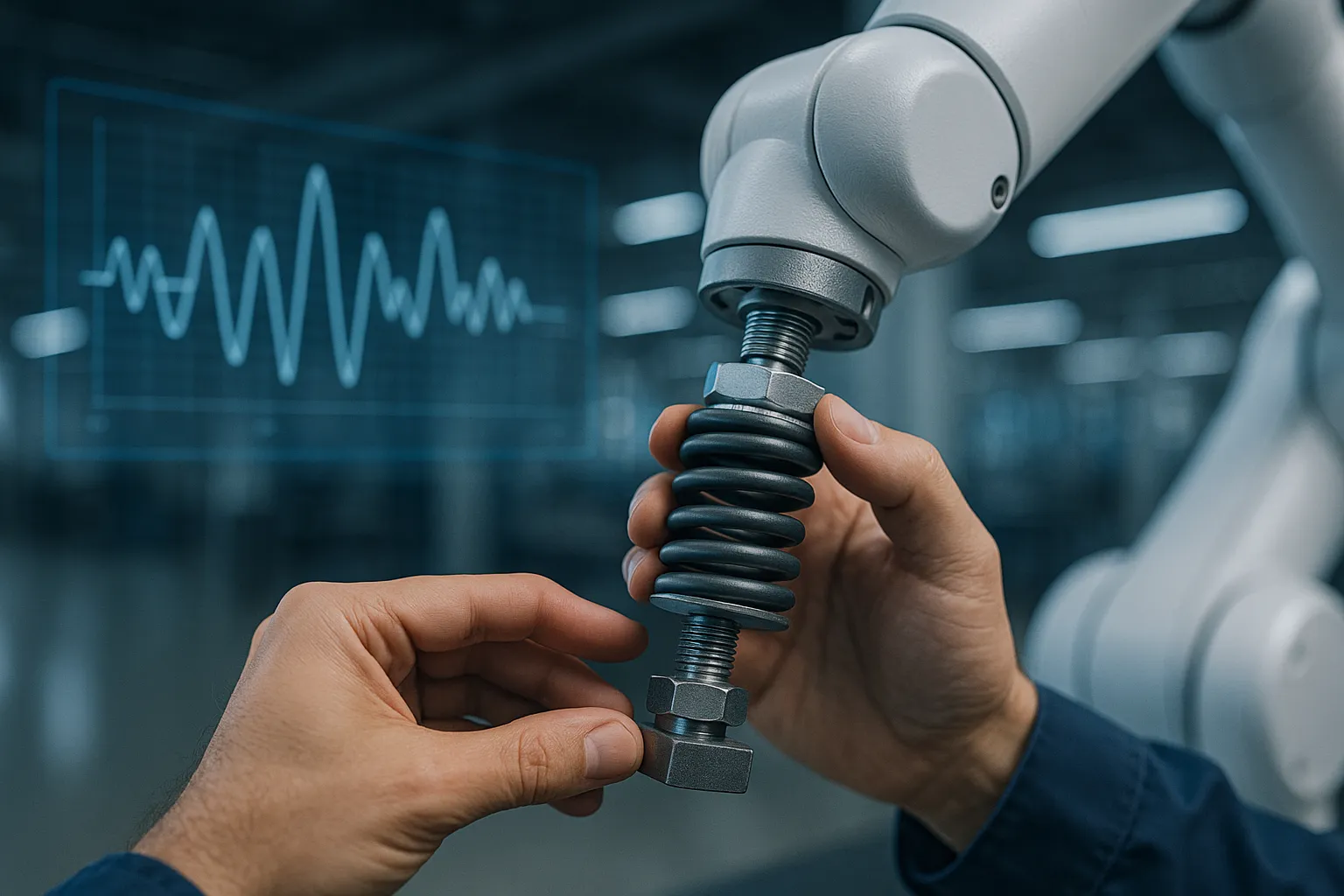
A product’s operational noise and the vibrations it produces during use are critical factors that significantly impact the user experience. Suppressing vibration and noise is an unavoidable challenge in defining a product’s value, especially for ensuring the quiet operation of home appliances, the ride comfort of automobiles, and the stable performance of precision equipment.
Standard screws are specialized for “fastening” parts, but they cannot completely suppress the micro-vibrations generated by operating machinery. This often leads to noise, loosening of parts, and ultimately, a shortened product lifespan.
This article focuses on the technology of “anti-vibration and sound-damping screws,” which solves these issues and provides products with the added value of “quietness” and “high durability.” We will provide a comprehensive explanation—from their mechanisms and specific types to their implementation effects and use cases in the Vietnamese manufacturing industry—to offer practical knowledge that will contribute to your company’s product development and quality improvement.
In product development, vibration and noise are not merely matters of comfort; they are business challenges directly linked to quality, safety, and brand image.
Modern products, with their increasing performance and miniaturization, tend to have built-in motors and fans with higher rotation speeds.
For example, it is not uncommon for a typical server cooling fan to exceed 10,000 revolutions per minute (RPM), which is a major cause of housing vibration and noise. According to the International Energy Agency (IEA), there were approximately 300 million industrial motors in operation globally as of 2022, and the vibration and noise emitted from this equipment cause problems such as the deterioration of the working environment and noise pollution in surrounding areas. In fact, a report by the World Health Organization (WHO) states that about 100 million people in Europe are exposed to traffic noise exceeding 55 decibels, and noise is recognized as an environmental factor that causes health problems. Unwanted noise from a product not only reduces customer satisfaction but also contributes to an increased failure rate of the equipment. One study suggests that vibration is responsible for about 30% of mechanical equipment failures.
Regulations regarding product noise levels are becoming stricter worldwide. The European Union (EU), for example, enforces the “Outdoor Noise Directive (2000/14/EC),” which sets maximum noise levels for equipment used outdoors, covering 57 types of equipment, including lawnmowers and generators. In Japan, the “Noise Regulation Act” imposes strict standards on specific factories and construction sites. Within the international quality management standard ISO 9001, factors such as vibration and noise are increasingly being considered indirectly in the requirements for product performance and reliability. Products that fail to comply with these regulations and standards face the risk of being restricted from the market or becoming subject to recalls.
Anti-vibration and sound-damping screws use special structures and materials to suppress the transmission of vibration and prevent the generation of noise. The technology can be broadly categorized into three approaches: “loosening prevention,” “vibration absorption,” and “vibration damping.”
The loosening of screws is the biggest factor that amplifies vibration. Once loosening occurs, a minute gap is created between parts, generating further vibration (rattling) and noise. “Locking screws” are used to prevent this.
Screws and related parts with vibration-absorbing functions utilize elastic materials such as rubber or special resins.
Key Data: Statistics on Vibration and Noise Countermeasures
– Percentage of industrial machinery failures caused by vibration: Approx. 30%
(Source: Various industry survey reports)
– Number of industrial motors in operation worldwide (2022): Approx. 300 million
(Source: International Energy Agency, IEA)
– Traffic noise level identified as a health risk by WHO: Over 55 decibels
(Source: WHO Regional Office for Europe)
– Number of equipment types covered by the EU Outdoor Noise Directive: 57
(Source: European Commission)
– Vibration transmission reduction rate by general anti-vibration rubber: Up to 70%-80%
(Source: Technical data from anti-vibration rubber manufacturers)
Source: [Multiple industry reports and international organization publications]
Vibration damping is a technology that prevents “resonance,” a phenomenon where a component vibrates excessively at a specific frequency. The “buzzing” sound from thin metal plates (e.g., PC case side panels, air conditioner outdoor unit covers) is caused by resonance.
In Vietnam, a hub for many manufacturing facilities including Japanese companies, the importance of vibration and noise countermeasures is growing for improving product quality and strengthening competitiveness.
Vietnam is one of the major home appliance production bases in Southeast Asia, with its appliance market size projected to reach approximately $13 billion in 2023. In air conditioners and washing machines, compressors and motors are the main sources of vibration. By using screws and mounts integrated with vibration-damping rubber, operational noise can be significantly reduced. For example, implementing anti-vibration screws in the mounting points of an outdoor unit’s compressor can lower the noise level to about 45 decibels (the level of a quiet library), which becomes a significant added value to promote the product’s quietness.
The number of registered motorcycles in Vietnam exceeds 65 million (as of 2022), making them the primary mode of transportation for the public. Vibrations from engines and exhaust systems not only compromise ride comfort but also cause screws in various parts to loosen. For muffler mounting bolts and engine mounts, wedge-locking washers that can withstand high-temperature environments and heat-resistant locking nuts are essential. This reduces the need for periodic re-tightening and can improve product reliability by 15% or more.
The Vietnamese government is promoting industrial advancement, leading to progress in factory automation (FA). FA lines and industrial robots repeat high-speed, precise movements, making misalignments and malfunctions due to vibration critical issues. Using screws made of damping alloys or gel bushings in the joints of robot arms and for mounting precision sensors suppresses micro-vibrations and maintains processing and assembly accuracy. This has been reported to reduce the defect rate on production lines by up to 5%.
We at OHTA VIETNAM are more than just parts suppliers. We are partners who provide optimal solutions to the vibration and noise challenges our customers face.
By combining the network of over 300 partner companies that our parent company, OHTA CO., LTD., has built in Japan with our local procurement network in Vietnam, we can propose a diverse range of anti-vibration/sound-damping screws, locking nuts, and washers. In addition to JIS and ISO standard products, we can handle orders for custom parts with special materials and shapes tailored to your product specifications, starting from even a single piece.
Utilizing our in-house inspection equipment, we conduct thorough quality control based on Japanese standards, even for parts procured in Vietnam. If required, we can submit vibration test data and material certificates (mill sheets) for parts. For customers unsure about which screw to select, our experienced technical staff will inquire about the product characteristics and usage environment to propose the best parts with a good balance of cost and performance. Vibration and noise countermeasures are most effective when considered from the initial stages of product design. Please feel free to consult with us right from the concept phase.
Vibration and noise emitted from products are no longer negligible quality indicators; they are critical factors that influence customer satisfaction and product lifespan. Utilizing the latest anti-vibration and sound-damping screw technology is one of the most effective investments to fundamentally solve these challenges and give products the distinct added value of “quietness,” “high durability,” and “high reliability.” By appropriately combining various technical approaches—such as “loosening prevention” with nylon lock or wedge-locking methods, “vibration absorption” with damping rubber or gels, and “vibration damping” with damping alloys—it is possible to dramatically improve the performance of all kinds of products, from home appliances to automobiles and industrial robots.
OHTA VIETNAM leverages its extensive product knowledge and global procurement network to strongly support our customers’ product development. When you face challenges with vibration and noise control, please do not hesitate to contact us, the “professionals in parts procurement.”
For inquiries regarding samples or materials, please respond to this email or contact our sales representative!
At Ohta Vietnam, we not only provide ready-made products such as screws and bolts, but also support activities in the manufacturing field such as cutting, inspection, assembly, packaging…
Our equipment list is here
As a “specialized support” for the manufacturing industry in Asia. If you have any related questions, feel free to contact Ohta Vietnam for detailed support!
URL: https://ohtavn.com/en/contact/