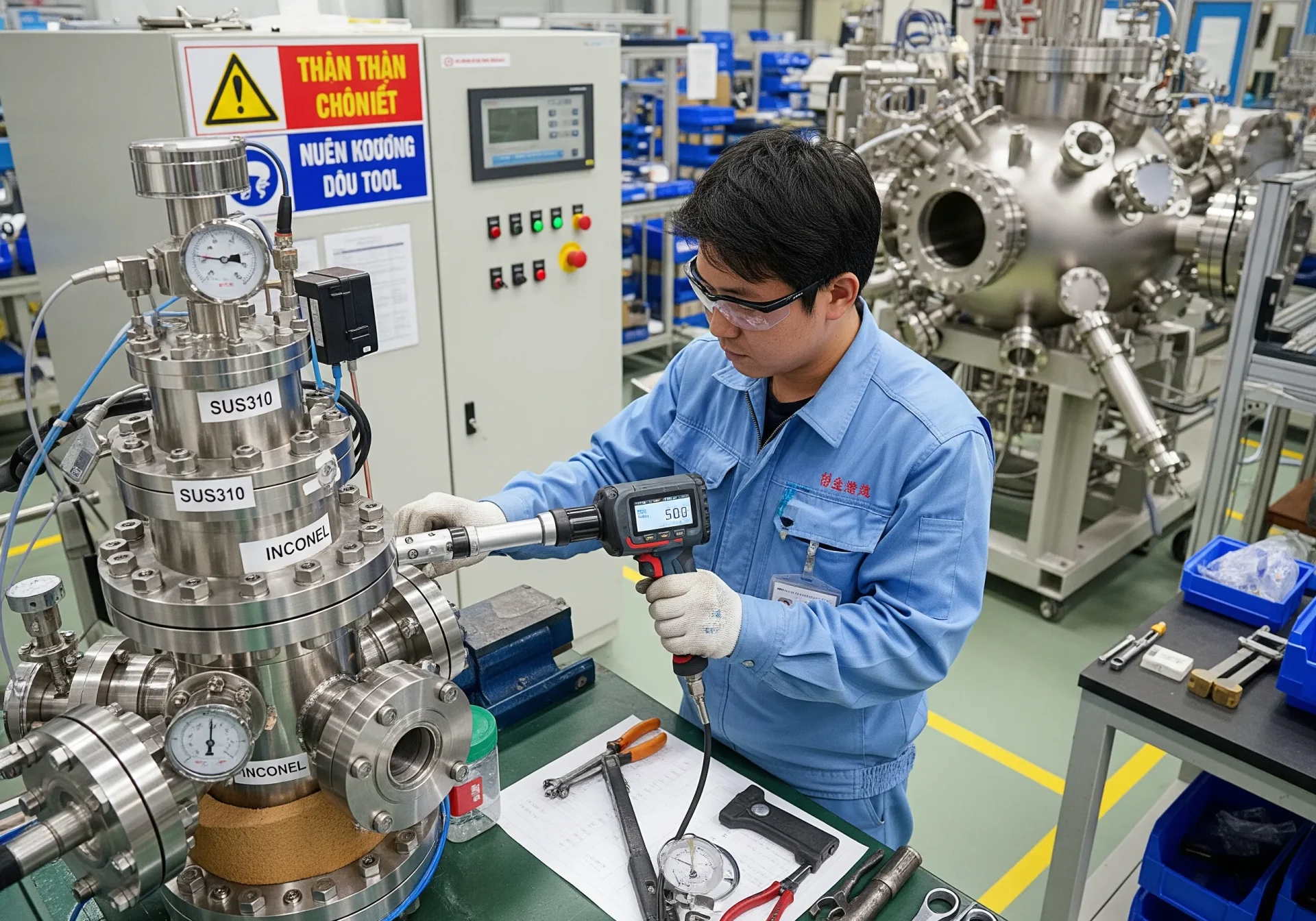
Introduction
This article provides practical insights for engineers on selecting screws that deliver reliability in harsh environments, such as those found in semiconductor manufacturing equipment, automobiles, and food processing facilities.
It offers an overview of risks and countermeasures in high-temperature, chemical, saltwater, and vacuum environments, covering materials, surface treatments, standards, and torque management. Focusing on “screw heat resistance” and “screw corrosion resistance,” it also presents key points for optimizing procurement in Vietnam. Furthermore, it concisely explains operational aspects such as galling prevention, calibration traceability, and fastening data management using IoT.
Fundamentals and Latest Trends in Heat and Corrosion Resistant Screws
Three Key Factors for Determining the Application Environment
The selection of heat and corrosion-resistant screws is organized around three points:
① operating temperature and atmosphere (oxidizing, reducing, vacuum, chemical),
② mechanical load (repeated, vibrational, impact),
③ material and surface condition.
The basic approach is to first define the temperature range and the media it will be exposed to, and then clarify the required axial force and frequency of disassembly.
Relationship Between Torque and Temperature (Key Design Points)
In the basic formula T = K・F・d (where K is the nut factor), K varies with lubrication, coating, surface roughness, and temperature.
At high temperatures, axial force tends to decrease due to thermal expansion differences and creep, compounded by lubrication degradation. Effective countermeasures include using low-friction coatings (PTFE/DLC, etc.), high-temperature compatible grease, employing the angle-control method, and planning for re-tightening after thermal cycles.
Corrosion Mechanisms and Risks
Corrosion mainly appears as pitting, crevice corrosion, and stress corrosion cracking (especially in Cl⁻ environments).
– In a vacuum, challenges include surface contamination and virtual leaks.
-With chemicals, material leaching and hydrogen embrittlement are issues.
– In seawater, the influence of chlorides is a major concern.
In addition to selecting the right materials (316L/duplex/Ni-based/Ti/PEEK), risks can be mitigated through passivation, electropolishing, and proper sealing and gas vent design.
Latest Trends in the Field
- Localized Optimization: A trend of “mixed optimization” is advancing, using Ni-based alloys for high-temperature parts, duplex stainless steel or Ti for hot water and seawater areas, and 316L for general parts.
- Galling Suppression: The risk of seizure is reduced by using low-friction coatings like DLC/CrN and PTFE, combined with appropriate tightening speeds and lubrication.
- Standardization of Vacuum Compatibility: Pump-down time is shortened and re-contamination is prevented by using vented screws, electropolishing, and precision cleaning.
- Traceable Operations: Smart torque wrenches are combined with calibration management to utilize fastening data for quality audits.
Implementation Points for Procurement in Vietnam
Vietnam’s environment is conducive to optimizing specifications through in-process changes for materials, surface treatments, and cleaning/packaging, responding to demands for high-mix, low-volume production. It is possible to propose solutions that minimize LCC (Life Cycle Cost) by avoiding over-specification through a gradual replacement from SUS to Ni-based alloys, Ti, or PEEK.
Optimal Design and Torque Management with Materials, Surface Treatments, and Standards (JIS/ISO)
Principles of Material Selection
In harsh environments, materials are selected with “localized optimization” according to temperature, media, and mechanical load.
– For high-temperature oxidation, SUS309/310 is used.
– For applications up to 700°C requiring high strength, Ni-based alloys (Inconel 625/718, etc.) are chosen.
– For seawater or chemical environments, SUS316L/duplex (2205, etc.) or Ti are used.
– For insulation, lightweight, and chemical resistance needs, PEEK is preferred.
It is also crucial to check the hardness and thermal expansion coefficient of the mating material to prevent galvanic corrosion from dissimilar metal contact.
Simple Matrix
| Environment/Requirement |
Recommended Candidates |
Design Notes |
| 800-1,100°C, Air |
SUS309/310 |
Maintain oxide film, design for expansion allowance considering thermal expansion differences. |
| Up to 700°C, High Strength + Corrosion |
Inconel 718/625 |
Combined measures against creep, oxidation, and chlorides. |
| Seawater, Salt Damage |
SUS316L/Duplex, Ti |
Measures against pitting and crevice corrosion, use with insulating washers. |
| Chemicals, Non-magnetic, Lightweight |
PEEK/Ceramic |
Use a longer thread engagement length, be mindful of thermal deformation. |
Selective Use of Surface Treatments and Finishes
- Passivation (e.g., equivalent to ASTM A967): Enhances corrosion resistance by removing free iron and strengthening the passive film. Also improves cleanability upon receipt.
- Electropolishing: Reduces dirt adhesion and galling by smoothing the surface. Effective for cleanability in vacuum, food, and pharmaceutical applications.
- Low-Friction Coatings (PTFE/PFA/PEEK): Suppresses torque variation and provides chemical resistance. Check specifications for continuous high-temperature use.
- PVD-based (DLC/CrN, etc.): Resistant to seizure and wear, suitable for repeated disassembly. Applied to sliding parts and high-load bolts.
- Caution: Zinc plating is unsuitable for high-temperature, strong acid, or strong alkaline environments. Avoid use outside of intended applications.
Standards and Acceptance Inspections (Centered on JIS/ISO)
- Mechanical Properties: For stainless steel, confirm the strength class and material designation with ISO 3506/JIS B 1054. For Ni-based alloys and Ti, the applicable JIS/ISO standards are limited, so specify them along with manufacturer specifications and ASTM/ASME standard sheets.
- Corrosion Resistance Evaluation: Use ISO 9227 (salt spray test) as a “comparative evaluation and QC indicator,” but avoid direct conversion to service life in the actual environment. Combine with exposure tests or specific chemical tests as needed.
- Traceability: Include heat lot/mill sheets, material certificates, RoHS/REACH compliance, and surface treatment certificates (passivation/electropolishing conditions) in the delivery specifications.
Practical Torque Management
Based on the formula T = K・F・d, the target torque T is determined from the desired axial force F. Since K (nut factor) varies with lubrication, coating, roughness, and temperature, correlation testing with actual bolts is recommended.
- Determining the K-value: With specified lubrication, coating, and tightening speed, measure the T-F correlation for n≥5 to set the control value from the average K and standard deviation.
- Using the Angle-Control Method: For joints with gaskets or where axial force reduction is a concern at high temperatures, suppress variation by applying a specified preliminary torque followed by angle-controlled tightening.
- Re-tightening Policy: Based on the residual axial force after thermal cycle testing, define whether to perform a follow-up tightening after the initial power-on/heating.
- Tool Calibration: Hand tools are periodically calibrated according to ISO 6789. For power tools, save logs of torque/angle/rotation speed and link them to operator IDs.
- Standardizing Work Procedures: Standardize the process: clean threads and seating surfaces → apply a thin layer of specified lubricant → tighten at or below the specified rotation speed → mark → record.
Design Pitfalls and Countermeasures
- Galling: Austenitic stainless steels are prone to seizure. Suppress this with dissimilar material pairings, DLC/PTFE coatings, and controlled tightening speeds.
- Insufficient Thread Engagement: Aim for ≥1.0d for metal-to-metal and 1.5-2.0d for resin or soft mating materials. Also, check the bearing pressure on the seating surface.
- Loosening: Nylon nuts are not suitable for high temperatures. Use all-metal lock nuts, double nuts, or spring washers, and ensure axial force with the angle-control method.
- Galvanic Corrosion: In seawater or humid environments, avoid contact between dissimilar metals. If necessary, use insulating washers and sealing materials.
Specification Template (Excerpt)
- Material: SUS310S / Inconel 718 / SUS316L / Ti Gr.2, etc. (specify by part)
- Surface: Passivation (conditions), Electropolishing (Ra limit), DLC/CrN or PTFE (coating thickness, friction coefficient)
- Torque: Target axial force, K-value, lubricant type, tightening speed, angle-control conditions
- Inspection: Dimensions, thread gauge, hardness, surface roughness, salt spray hours (for comparison), tool calibration records
- Traceability: Lot, mill sheet, cleaning and packaging specifications (cleanliness level)
Common Failures and Corrections
- Leakage despite passing torque inspection: Review seating surface roughness and gasket selection, switch to the angle-control method.
- Premature corrosion: Caused by cleaning residues or salt transfer. Prevent recurrence with electropolishing, pure water cleaning, and individual packaging.
- Screw fracture: Caused by underestimating the K-value or excessive tightening speed. Correct with on-site correlation tests and rotation speed management.
Optimizing Vietnam Procurement and On-site Operations: Ohta Screw Solutions
Why Procurement in Vietnam is Advantageous (High-Mix, Low-Volume Production × Rapid Prototyping)
Vietnam is suitable for procuring high-mix, low-volume screws on short lead times because it can quickly handle everything from tooling and surface treatment to cleaning and packaging locally. Ohta Vietnam offers a one-stop solution, providing materials that meet heat and corrosion resistance requirements (SUS310/Inconel/Ti/PEEK, etc.) and services including passivation, electropolishing, DLC/PTFE coating, UHV-compatible cleaning, and individual packaging (with desiccant/nitrogen sealing). Cross-process traceability is also ensured through mill sheets, lot tracking, and laser marking.
On-site Implementation Flow (Prototyping → Mass Production → Operation)
- Requirement Definition: We conduct hearings on the temperature range, media (seawater, chemicals, vacuum), disassembly frequency, and tightening method (torque/angle).
- Material and Surface Treatment Selection: We perform “mixed optimization” of SUS/Ni-based/Ti/resin for each part, simultaneously evaluating galling and galvanic corrosion risks.
- Correlation Testing: We measure the K-value (under specific lubrication, coating, and temperature conditions) with actual bolts to determine the set torque for the target axial force.
- Mass Production Launch: We establish an SLA for pass criteria (Ra, cleanliness, coating thickness, friction coefficient) and define the calibration cycle for inspection jigs and torque tools.
- Training and Standardization: We provide work procedure manuals (clean → lubricate → tighten → mark → record) and conduct on-site training.
- Operational Improvement: We analyze failure logs with SPC and continuously propose improvements such as material changes, coating modifications, or adoption of the angle-control method.
Quality and Traceability Management (Audit Compliance)
- Evidence Set: We deliver a complete set of documents including mill sheets, RoHS/REACH compliance, surface treatment certificates (A967 equivalent/electropolishing conditions), cleaning/packaging specifications, and tool calibration records (ISO 6789).
- Lot Tracking: We link laser markings with packaging labels, enabling tracking down to the part, torque value, and operator ID.
- Vacuum and Chemical Compatibility: For UHV applications, we perform degreasing → ultrasonic cleaning → pure water rinsing → drying → clean packaging. For chemical applications, we support extraction tests and leaching management.
Logistics and Inventory Optimization (VMI / MTO / Emergency Arrangements)
| Model |
Features |
When to Use |
| VMI (Vendor-Managed Inventory) |
Absorbs demand fluctuations with local warehouse stock, replenishes fixed quantities. |
For standard items and common parts across multiple locations. |
| MTO (Make-to-Order) |
Optimizes material, surface treatment, and cleaning specifications for each order. |
For custom, high-mix low-volume, or frequently changing designs. |
| Emergency Arrangement |
Recovers within 24-72 hours with alternative materials or temporary specifications. |
When avoiding a line stoppage is the top priority. |
| We minimize lead time and total cost by selectively using Incoterms (FOB/CIF/DDP) and milk runs. |
|
|
Specification and Order Template (Copy and Use)
- Item: M8×25 Hex Bolt (example) / Thread JIS 6g / Surface Ra≤0.8 μm
- Material: Inconel 718 (flange part) / SUS316L (general part)
- Surface: Passivation, Electropolishing, PTFE coating (friction coefficient 0.10±0.02 / thickness 8–12 μm)
- Cleaning/Packaging: UHV compatible (degreasing → pure water → clean packaging / individual wrapping / desiccant included)
- Torque Management: Target axial force X kN, K=0.12 (test value), specify angle-control + re-tightening conditions
- Inspection: Dimensions, thread gauge, surface roughness, salt spray (for comparison), tool calibration records
- Traceability: Lot/Heat, laser marking (part code + date)
KPIs and Visualization (Monthly Review)
- Fastening Defect Rate (ppm) / Re-tightening Rate / Galling Incidents / Lead Time / Inventory Turnover.
- We visualize these on a dashboard by process and part to continuously optimize the balance of Cost/Quality/Delivery (QCD).
Case Study (Summary)
- For a 700°C exhaust system part, switching from SUS to Inconel + PTFE resulted in zero galling, a 50% reduction in re-tightening, and a 15% cut in total maintenance costs.
- For a semiconductor jig, using SUS316L vented screws with electropolishing and UHV cleaning shortened pump-down time by 20%. In both cases, the process from prototyping to correlation testing and mass production was completed in Vietnam within four weeks.
Summary
- The selection axis is “Temperature × Atmosphere × Load × Cost.” Work backward from actual machine conditions to clarify the required axial force and disassembly frequency.
- Material Selection: SUS309/310 (high-temp oxidation), Inconel 625/718 (up to 700°C + high strength), 316L/duplex/Ti (seawater, chemicals), PEEK (insulation, lightweight).
- Surface/Finishing: Achieve both corrosion resistance and torque stability with passivation/electropolishing/PTFE, DLC, CrN. For vacuum, standardize on vented screws + cleaning and individual packaging.
- Torque Management: T = K・F・d. The K-value varies with lubrication, temperature, and roughness—determine it through correlation tests and operate with a set plan for angle control and re-tightening.
- Quality and Audit Compliance: Ensure traceability with ISO 3506, JIS B 1054, ISO 9227, ISO 6789, and lot/mill sheet management.
- Strengths of Vietnam Procurement: Strong in high-mix, low-volume production and short lead times, enabling end-to-end optimization from prototyping to mass production and operational improvement.
From defining requirements for “screw heat resistance” and “screw corrosion resistance” to creating specifications, conducting K-value correlation tests, and on-site implementation, Screw Solutions will support you. Please start by sharing your current specifications and challenges.
At Ohta Vietnam, we not only provide ready-made products such as screws and bolts, but also support activities in the manufacturing field such as cutting, inspection, assembly, packaging…
Our equipment list is here
As a “specialized support” for the manufacturing industry in Asia. If you have any related questions, feel free to contact Ohta Vietnam for detailed support!
URL: https://ohtavn.com/en/contact/