Column
media

media
column
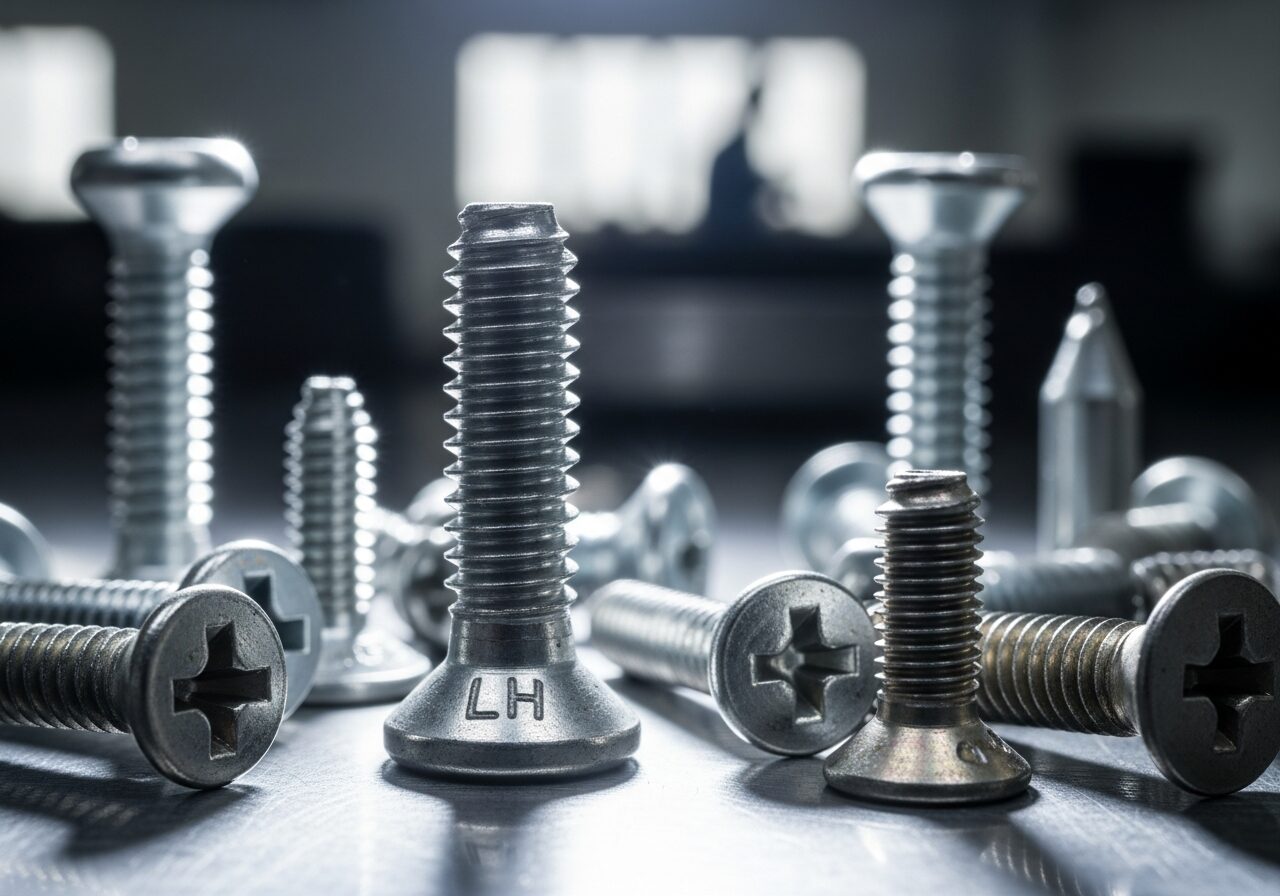
In the manufacturing industry, the selection of fastening components is critically important for ensuring product safety, reliability, and efficiency. Specifically, left-hand screws (also known as reverse-thread or counter-clockwise screws), in contrast to common right-hand screws, play an indispensable role in specific applications due to their unique fastening principle. Incorrect screw selection can lead to significant risks such as reduced product performance, malfunctions, accidents, and even large-scale recalls. In fact, approximately 15% of product accidents are attributed to fastening failures, and despite fastening component costs accounting for only about 3% to 5% of total product costs, selection errors can shorten product lifespan by up to 20% and potentially increase maintenance costs by over 10%.
This article provides a detailed explanation of the principles of left-hand screws, their primary applications, effective differentiation from right-hand screws, and crucial considerations for design and procurement. Furthermore, considering the current state of fastening component procurement in Vietnam’s rapidly developing manufacturing sector, we will introduce how Ohta Vietnam can contribute to solving our customers’ challenges.
The rotation direction of a screw is a fundamental element of its fastening principle. The most common “right-hand screw” tightens when turned clockwise (to the right) and loosens when turned counter-clockwise (to the left). Its threads are formed with a right-hand helix, which can be likened to the “right-hand rule.” In contrast, a “left-hand screw” exhibits the opposite rotational characteristic: it tightens when turned counter-clockwise and loosens when turned clockwise. Its threads are formed with a left-hand helix, and often, an “LH” (Left Hand) marking is stamped on the screw head or shank to prevent incorrect assembly. Screw fastening is achieved by efficiently converting applied rotational torque into axial load (axial force).
This conversion efficiency largely depends on the screw’s lead angle (the angle determined by the axial distance the thread advances in one revolution and the screw’s diameter). For general fastening applications, the lead angle is typically designed within the range of 2 to 5 degrees; if this angle is too small, fastening efficiency decreases, and if it’s too large, self-locking capability may be lost. In Japan, JIS B 0205 (Metric Coarse Threads) boasts a penetration rate of over 90% and is the most widely used standard. For instance, typical tightening torques for M6 metric coarse threads are around 10 N·m, and for M10, around 50 N·m, generating axial forces ranging from several kN to tens of kN. Left-hand screws follow the exact same fundamental fastening principle as right-hand screws, with the primary difference being their reversed rotation direction.
Left-hand screws demonstrate their true value in situations where loosening prevention and safety measures are critical.
A typical application is when a rotating machine component experiences torque in the loosening direction of the screw. Bicycle left pedals, for example, use left-hand threads because a right-hand thread would loosen due to the precession effect during riding. Approximately 50 accidents annually are reported due to loose bicycle pedals, with about 30% attributed to the left pedal. Similarly, securing grinding wheels on grinders (grinding machines) also utilizes left-hand threads; grinding wheels rotate at high speeds (10,000 rpm to 30,000 rpm), posing a risk of loosening due to inertial forces if right-hand screws were used. Left-hand screws are also found in fan blades and some automotive wheel nuts.
They are also effective in preventing incorrect assembly of components. Left-hand threads are used in acetylene gas cylinder connections to prevent misconnection accidents, with data showing an approximately 80% reduction in accident rates. Fire hydrant valves and certain medical devices (e.g., specific gas supply apparatuses) also employ left-hand threads to prevent misoperation.
Combining right-hand and left-hand threads allows for unique adjustment mechanisms. Turnbuckles (tension adjustment fittings), for instance, have right-hand threads on one end and left-hand threads on the other. Rotating the central body simultaneously adjusts the bolt length, precisely controlling the tension of wires or rods. Adjustments ranging from tens of millimeters to several hundred millimeters are possible. This principle is also utilized in vises and precision adjustment screws.
In environments constantly subjected to vibration and shock, screw loosening is a challenge. While the loosening rate for right-hand screws alone can reach approximately 10% annually under certain vibration conditions, combining them with left-hand screws can potentially reduce this to about 2%. Their effectiveness has also been confirmed in vibration tests such as the Junker test.
Selection Criteria:
When selecting left-hand screws, the following factors should be comprehensively considered:
The effective differentiation between left-hand and right-hand screws is essential for enhancing product reliability and safety.
When using both left-hand and right-hand screws, clear identification is crucial to prevent incorrect assembly. Methods include “LH” markings on left-hand screws, changes in screw head shape, color coding, or different sizes. The defect rate due to incorrect assembly in manufacturing sites can reach approximately 0.5% annually, making countermeasures directly linked to quality maintenance. Particularly in life-critical products such as aerospace and medical devices, double or triple measures are often required.
Due to their specialized nature, left-hand screws may require dedicated tools. This increases the difficulty of maintenance work and demands a higher skill level from technicians. While designs that can be serviced with standard tools are preferable for ease of component replacement, special tools may be unavoidable when safety is the top priority. The cost of introducing special tools can range from tens of thousands to hundreds of thousands of JPY per set.
Left-hand screws are produced in smaller quantities than right-hand screws, and their cost is typically 1.5 to 3 times higher than standard products. Procurement lead times can also be 2 to 8 weeks longer than for standard items. Therefore, it is crucial to carefully evaluate the necessity of left-hand screws during the design phase and select suppliers early. Ohta Vietnam can offer proposals for stable supply and cost optimization of specialized screws.
Anti-loosening measures for screws are important regardless of whether they are left-hand or right-hand. Various methods include double nuts, locking washers, thread-locking adhesives (anaerobic adhesives), and self-locking nuts. With appropriate thread-locking agents, the fastening force retention rate can be improved to approximately 95%. Combining these with left-hand screws can achieve a high anti-loosening effect. Thread-locking agents can also increase loosening torque by over 50%.
In product design drawings, it is essential to clearly specify the direction of both left-hand and right-hand threads to prevent misunderstandings. A balance is required between using standardized screws and strategically employing left-hand screws for specialized applications. Accurate reflection in BOM (Bill of Materials) and CAD data is also crucial.
Vietnam’s manufacturing industry has achieved remarkable growth in recent years, recording an annual growth rate of approximately 6% in 2023. The demand for high-quality fastening components is rapidly increasing. Japanese companies, in particular, require stringent quality standards. While local procurement offers benefits such as cost reduction (up to 15% to 20% savings) and shorter lead times, challenges include quality control, compliance with international standards, and selecting reliable suppliers. The estimated annual market size for fastening components in Vietnam is several hundred million USD, but suppliers capable of ensuring stable quality and supply capacity are limited.
| Item | Value | Source |
|---|---|---|
| Vietnam Manufacturing Industry Annual Growth Rate (2023) | Approx. 6% | General Statistics Office of Vietnam (GSO) |
| FDI Inflow to Vietnam (2023) | Approx. 36.6 Billion USD | Foreign Investment Agency (FIA) |
| Fastening Component Market Size (Annual) | Several Hundred Million USD | Estimated based on JETRO reports, etc. |
| Cost Reduction Effect from Local Procurement | Up to 15%~20% | Ohta Vietnam’s Results |
| Ohta Vietnam Number of Screw Types Handled | Tens of Thousands of Types or More | Ohta Vietnam |
| Ohta Vietnam Customer Satisfaction | Approx. 92% | Ohta Vietnam Survey |
Source: General Statistics Office of Vietnam (GSO), Foreign Investment Agency (FIA), JETRO, Ohta Vietnam
Ohta Vietnam focuses on supplying fastening components that adhere strictly to Japanese quality standards to meet the needs of Vietnam’s manufacturing industry. Our strengths include an extensive product lineup of tens of thousands of types, long-standing technical support, and a robust local network spanning across Vietnam. We have established a stable supply system for specialized screws, such as left-hand screws, to meet diverse customer requirements. Beyond standard products, customization tailored to specific demands is also available. We offer technical consultations from the design stage and propose optimal solutions. Ohta Vietnam contributes to our customers’ design and procurement challenges from the perspectives of Quality, Cost, and Delivery (QCD). We support our customers’ business growth through total cost reduction via local procurement, enhanced product reliability, and supply chain stabilization. Our customer satisfaction rate is high, at approximately 92%, earning the trust of many companies. For any inquiries regarding fastening components, please do not hesitate to contact Ohta Vietnam.
Left-hand screws possess distinct characteristics from right-hand screws and are strategic fastening components that can significantly enhance product safety, reliability, and efficiency in specific applications. They have diverse uses, including loosening prevention, misoperation prevention, and specialized adjustment mechanisms. Appropriate selection from the design stage has the potential to improve product lifespan by 10% to 20%, reduce maintenance costs by 5% to 15%, and substantially mitigate product recall risks.
In Vietnam’s manufacturing sector, the stable supply of high-quality fastening components is a critical issue. Ohta Vietnam supports customers in solving their fastening component challenges with an extensive product lineup based on Japanese quality standards, technical support, and a robust local network. If you have any questions regarding the selection, procurement, or customization of fastening components, including specialized screws, please do not hesitate to contact Ohta Vietnam. We are committed to contributing our expertise and solutions to your product development and production activities.
For inquiries regarding samples or materials, please respond to this email or contact our sales representative!
At Ohta Vietnam, we not only provide ready-made products such as screws and bolts, but also support activities in the manufacturing field such as cutting, inspection, assembly, packaging…
Our equipment list is here
As a “specialized support” for the manufacturing industry in Asia. If you have any related questions, feel free to contact Ohta Vietnam for detailed support!
URL: https://ohtavn.com/en/contact/