The Importance of Procurement Cost Visibility: Reducing Hidden Cost...
Column
media
column
The Importance of Procurement Cost Visibility: Reducing Hidden Costs and Enhancing Competitiveness in Vietnamese Manufacturing
Introduction: The Reality of Manufacturing Where Invisible Costs Erosion Profits
Today’s manufacturing industry faces intensified global competition and market fluctuations, making profit margin assurance an urgent challenge. For many manufacturers, the average operating profit margin is typically around 3% to 5%, meaning even slight cost reductions can significantly impact corporate earnings. Within this context, procurement costs often constitute a very high proportion of a product’s manufacturing cost, frequently accounting for 50% to 70% of sales revenue.
However, many companies tend to focus solely on the direct cost of parts, namely the “purchase price.” In reality, “hidden costs” concealed behind the purchase price quietly but surely erode corporate profits. Quality defects, excess inventory, inefficient supplier management, and complex administrative processes all invisibly strain a company’s cash flow and diminish its competitiveness.
Against this backdrop, “procurement cost visibility”—accurately grasping the overall picture of procurement costs and identifying and reducing hidden costs—is no longer just an option but an indispensable element of business strategy. Ohta Vietnam is committed to providing concrete solutions to help Vietnamese manufacturers overcome these challenges and achieve sustainable growth.
The Full Scope of Procurement Costs and the True Nature of “Hidden Costs”
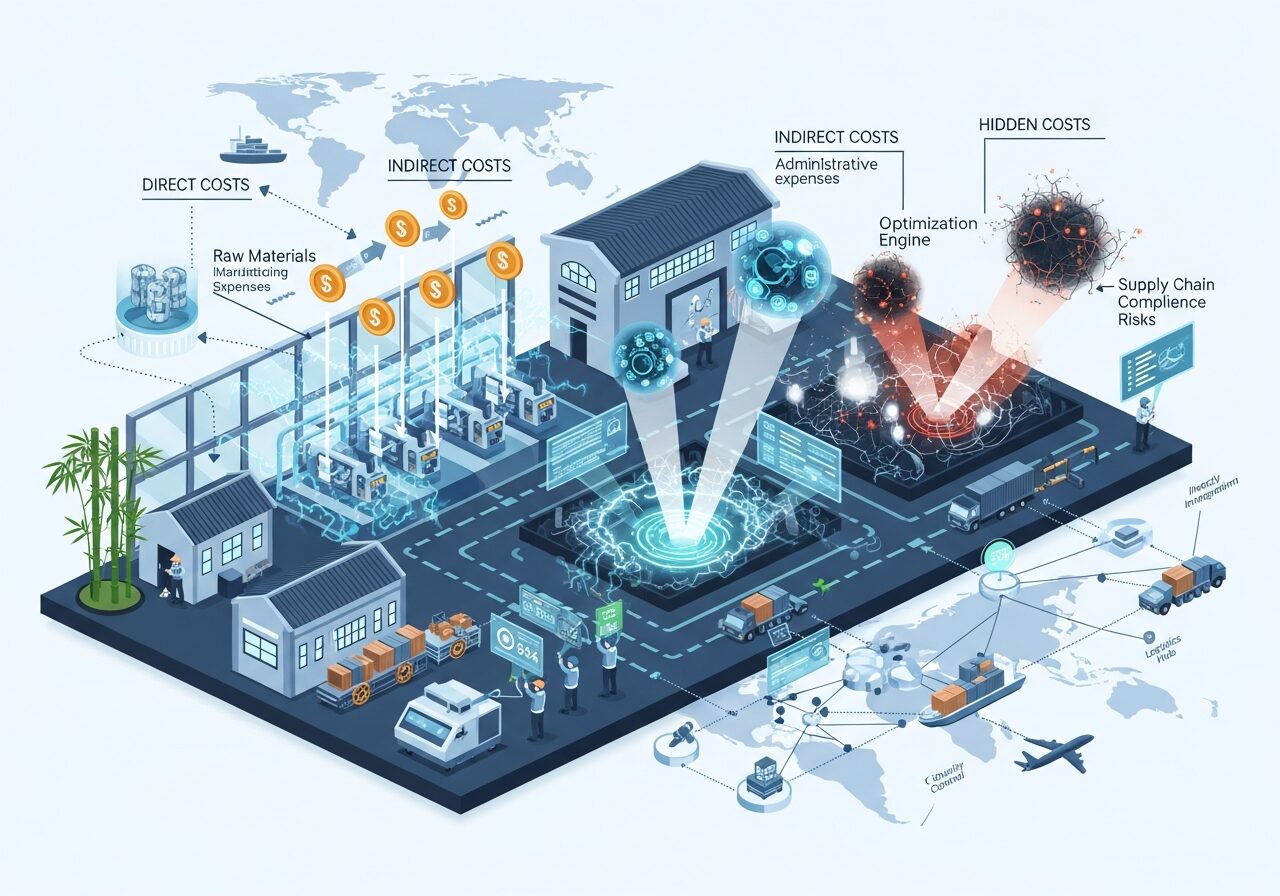
Procurement costs can be broadly categorized into “direct costs” and “indirect costs.” Direct costs are expenses directly tied to the product, such as the purchase price of parts and raw materials, freight, and customs duties. In contrast, indirect costs refer to expenses incurred across the entire procurement activity, though not directly linked to the product itself, such as quality inspection costs, inventory management costs, purchasing department personnel expenses, supplier selection costs, and administrative processing fees.
A particularly crucial concept is TCO (Total Cost of Ownership). This approach considers not just the purchase price but all costs incurred throughout the product’s entire lifecycle. Research indicates that TCO can be 2 to 3 times the purchase price, highlighting the significant magnitude of hidden costs. The main hidden costs included in TCO are as follows:
Costs due to Quality Defects: The occurrence of defective products generates a wide range of costs, including rework expenses, disposal costs, re-inspection fees, and opportunity losses from production line stoppages. In some industries, costs due to quality defects can amount to 0.5% to 5% of sales revenue.
Inventory-Related Costs: Excessive inventory incurs storage costs, management fees, obsolescence risks, and insurance premiums. Conversely, inventory shortages lead to opportunity losses due to production stoppages or delivery delays.
Logistics and Customs Clearance Costs: This includes not only transportation costs but also customs clearance fees, warehousing costs, packaging costs, and foreign exchange fluctuation risks. It is not uncommon for logistics costs to account for 5% to 15% of the product’s cost of goods sold.
Supplier Management Costs: Personnel expenses and travel costs associated with supplier selection, evaluation, negotiation, auditing, and quality improvement guidance are also hidden costs.
Administrative Processing Costs: The time and personnel expenses involved in administrative tasks within the purchasing process, such as purchase order placement, invoice processing, and contract management, are also significant costs that cannot be ignored.
Estimated Proportion of Hidden Costs in Manufacturing
Cost Item
Proportion of Sales Revenue
Proportion of Purchase Price
Quality Defect Costs
0.5% ~ 5%
–
Logistics Costs
5% ~ 15%
–
TCO (Total Cost of Ownership)
–
2~3 times purchase price
Inventory-Related Costs
1% ~ 3%
–
Supplier Management Costs
0.5% ~ 2%
–
Source: Industry research reports, analysis by consulting firms (e.g., Deloitte, PwC)
Concrete Benefits of Procurement Cost Visibility: Enhanced Decision-Making and Competitiveness
By making procurement costs visible, companies can reap numerous benefits beyond mere cost reduction. This enables data-driven decision-making and fundamentally strengthens a company’s competitive edge.
Data-Driven Supplier Selection and Enhanced Negotiation Power: By comparing and analyzing the TCO for each supplier, companies can objectively select the most cost-efficient suppliers. This has reportedly led to annual cost reductions of 5% to 15% in some cases. Furthermore, concrete data serves as a powerful tool in price negotiations with suppliers.
Inventory Optimization and Cash Flow Improvement: Accurate demand forecasting and visibility into procurement lead times can reduce excess inventory and stockouts, optimizing inventory levels. Inventory reduction can potentially free up 10% to 30% of working capital, significantly improving a company’s cash flow. Shortening lead times by just 10% can also lead to a few percent reduction in inventory costs.
Early Detection and Response to Quality Issues, Reduced Defect Rates: Visualizing quality-related costs allows companies to identify the sources and frequency of defects, enabling early implementation of corrective measures. This reduces defect rates and cuts down on rework expenses and customer complaint handling costs.
Strengthened Overall Supply Chain Risk Management: By making supplier financial health, on-time delivery rates, and quality performance visible, potential risks can be identified early. This enables appropriate risk hedging strategies, such as securing alternative suppliers or revising inventory strategies.
Enhanced Inter-Departmental Collaboration and Operational Efficiency: Procurement cost visibility encourages departments such as purchasing, production, quality control, and finance to collaborate on problem-solving based on shared data. This strengthens inter-departmental cooperation, promotes standardization and automation of purchasing processes, and improves operational efficiency.
Challenges in Procurement Cost Reduction for Vietnamese Manufacturing and Ohta Vietnam’s Role
Vietnam is a major manufacturing hub in the ASEAN region, sustaining annual economic growth of 6% to 8%, with approximately 2,000 Japanese companies operating there. However, beneath this growth, Vietnamese manufacturing faces unique challenges regarding procurement cost reduction.
Supply Chain Complexity and Challenges in Local Sourcing: Vietnam’s domestic supplier network is still in a developing stage, making local sourcing of high-precision parts or specialized materials particularly challenging. This often necessitates reliance on imports, leading to longer lead times and increased logistics costs.
Hidden Costs Due to Exchange Rate Fluctuations, Customs Procedures, and Cultural/Business Practice Differences: In international procurement, exchange rate fluctuations pose a risk of impacting cost increases or decreases by several percent annually. Furthermore, the complexity of Vietnam’s unique customs procedures, different business practices from Japan, and communication barriers also invisibly drive up costs.
Challenges in Selecting and Managing Local Suppliers Meeting Japanese Quality Standards: It is not easy to find and continuously manage local suppliers that meet the high-quality standards required by Japanese companies. Establishing quality control systems and providing technical guidance demand significant time and resources.
To address these unique challenges in Vietnam, Ohta Vietnam leverages its specialized expertise in fastening components (screws, nuts, washers, etc.) and its extensive local network to strongly support customers in reducing procurement costs. We don’t just supply parts; we provide consulting and concrete solutions to optimize our customers’ entire supply chains. For instance, by implementing VMI (Vendor Managed Inventory), we help reduce customers’ inventory management burden and contribute to inventory cost reduction.
Ohta Vietnam contributes to the overall optimization of procurement costs across the manufacturing industry by focusing on seemingly small components: fastening parts. Fastening components are indispensable elements in product assembly, and their types are diverse. However, their procurement management is often overlooked, and this is where significant hidden costs can reside.
Procurement Consulting and Supplier Evaluation Specialized in Fastening Components: Based on your product specifications and quality requirements, we meticulously select the most suitable fastening component suppliers from within Vietnam and internationally. We have a proven track record of reducing fastening component procurement costs by 10% to 20%.
Proposal for the Optimal Combination of Local and Imported Sourcing: We comprehensively evaluate cost, quality, lead time, and risk to propose the ideal balance between local and imported sourcing. This enhances supply chain flexibility and ensures stable supply.
Quality Assurance System and Minimization of Defect Occurrence Risk: Ohta Vietnam enforces rigorous quality control standards, including thorough supplier audits, incoming inspections, and pre-shipment inspections. Our goal is to keep the defect rate below 0.1%, significantly reducing our customers’ quality-related costs.
Inventory Management Optimization and Lead Time Reduction: By implementing VMI and consignment inventory systems, we reduce our customers’ inventory burden and improve cash flow. In fact, there are cases where VMI implementation reduced customer inventory days by 30%. Furthermore, we establish a rapid supply system from local warehouses to shorten lead times, enhancing production planning flexibility.
Identification of Hidden Costs and Development of Concrete Reduction Plans: We conduct a detailed analysis of your current procurement processes to identify often-overlooked indirect costs and TCO elements. We then set specific numerical targets and collaboratively develop and execute feasible reduction plans.
Optimizing the procurement of fastening components is the first step towards overall supply chain efficiency and cost reduction. Ohta Vietnam is committed to helping your business succeed in Vietnam as your trusted procurement partner.
Summary: Achieving Sustainable Growth Through Procurement Cost Visibility
Procurement cost visibility in manufacturing is not merely about cost reduction; it is a critically important strategic initiative. By identifying invisible “hidden costs” and optimizing the entire supply chain, companies can establish a competitive advantage and achieve sustainable growth.
A wide range of hidden costs, such as those from quality defects, excess inventory, and inefficient supplier management, significantly pressure corporate profits. By making these costs visible and implementing concrete countermeasures, an annual profit improvement of several percent can be expected. For example, if supply chain costs can be reduced by an average of 5% over the next five years, corporate profits could substantially increase.
Ohta Vietnam offers optimal solutions to the procurement cost challenges faced by Vietnamese manufacturers, leveraging its specialized expertise in fastening components and extensive local network. As a first step towards understanding the full scope of procurement costs and reducing hidden costs, we invite you to consult with Ohta Vietnam. We are committed to being a strong partner in helping your business further develop in Vietnam.
Conclusion
For inquiries regarding samples or materials, please respond to this email or contact our sales representative!
At Ohta Vietnam, we not only provide ready-made products such as screws and bolts, but also support activities in the manufacturing field such as cutting, inspection, assembly, packaging…
Our equipment list is here
As a “specialized support” for the manufacturing industry in Asia. If you have any related questions, feel free to contact Ohta Vietnam for detailed support!
URL: https://ohtavn.com/en/contact/