Column
media

media
column
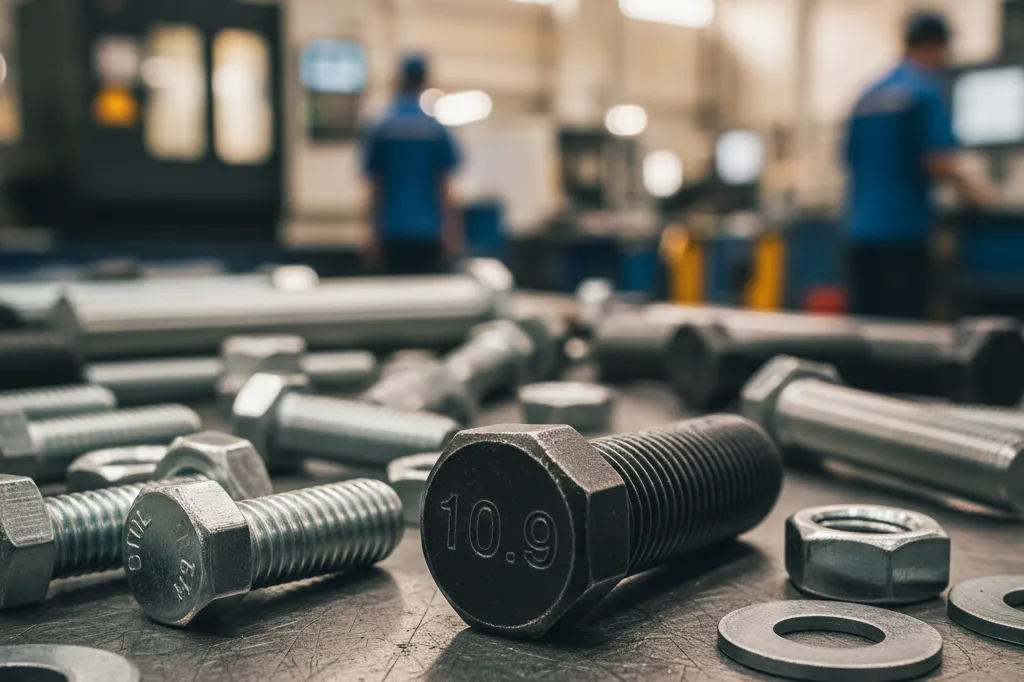
In the manufacturing industry, the “bolt” is a critical component that, while basic, dictates product quality and safety. Approximately 2,000 to 3,000 bolts and nuts are used per automobile, and the failure of just one can lead to serious accidents. However, ambiguous instructions like “Bring me an M6 bolt” are common on the factory floor, often leading to overlooked differences in property classes or surface treatments. Particularly in Vietnam, which has become a key point in supply chains in recent years, stably procuring Japanese-quality fasteners at appropriate prices is an urgent issue for many companies.
In this article, we will explain everything from the basic definition of bolts and how to read often-overlooked property classes to optimal procurement strategies in Vietnam, summarizing the points procurement and technical staff need to know in 3 minutes. Including the hybrid “Trading Company x Manufacturer” solution provided by Ohta Vietnam, we deliver information to update your procurement operations.
Generally, “Bolts” are included within the broad classification of “Screws,” but a clear distinction exists in JIS standards (Japanese Industrial Standards) and practical field work.
The biggest difference is “whether or not it is used in combination with a nut.”
Items that are tightened solely into a female thread (tapped hole) cut into the target object are called “Machine Screws.” On the other hand, items that pass through the target object and are fixed by tightening with a nut from the opposite side are defined as “Bolts.” However, since hexagon bolts are sometimes screwed into tapped holes, it is also common to distinguish them by shape (those with large heads like hexagons that are turned with a spanner or wrench).
Bolts are mainly composed of the following three elements.
The “designation” when ordering is expressed as “Thread Diameter (M) x Length (L).” For example, “M10×50” means the outer diameter of the thread is 10mm and the length under the head (length excluding the head) is 50mm. Misunderstanding this is the biggest cause of ordering errors, so caution is required.
You may have seen markings like “4.8” or “10.9” on the head of a bolt. These are important indicators showing the bolt’s “Tensile Strength” and “Yield Point (Proof Stress).”
For example, in the case of the notation “10.9”:
In other words, a 10.9 bolt breaks at 1,000 N/mm² and returns to its original state up to 900 N/mm² (elastic deformation range), indicating extremely high strength. Compared to “4.6” or “4.8” used in general steel frame construction, its strength is more than double.
In manufacturing sites in Vietnam, the following materials are mainstream.
There are roughly two methods for manufacturing bolts.
What many companies expanding into Vietnam face is the wall of “high-mix low-volume” production, such as “Special bolts used in Japan are not available locally” or “We only want 100 pieces for prototyping.” While local suppliers are strong in mass production (cold heading), there are cases where challenges remain in their ability to respond to such detailed needs and in quality control.
Ohta Vietnam approaches this challenge from both the “Trading Company” and “Manufacturer” sides.
The tightening force (axial force) of a bolt is controlled by torque management. However, the torque coefficient varies greatly depending on the lubrication state. Even when tightened with the same torque, the axial force can differ by 1.5 to 2 times between when oil is applied and when it is dry. Since insufficient tightening leads to loosening and overtightening leads to breakage, numerical management using a torque wrench is essential.
When metals with a potential difference come into contact via moisture (electrolyte), such as when using stainless steel bolts on an aluminum base material, the metal with the higher ionization tendency (aluminum in this case) corrodes rapidly. To prevent this, the use of insulating washers or the selection of appropriate surface treatments (such as Geomet treatment or electro-galvanizing) is important.
Particularly with stainless steel bolts, “seizure,” where screw threads fuse together due to frictional heat during tightening, tends to occur easily. To prevent this, keeping the tightening speed low or applying anti-seizure agents such as Molybdenum Disulfide is effective.
Bolts are not just fasteners but functional parts that guarantee the safety and performance of machinery. Their selection requires a deep understanding not only of dimensions but also of property classes, materials, surface treatments, and manufacturing methods (heading or machining).
Especially in the rapidly growing Vietnam market, optimizing the “procurement portfolio”—sourcing mass-produced items locally and high-precision, special, or small-lot items from reliable Japanese partners—is the key to balancing cost and quality.
Based in Dong Nai Province in southern Vietnam, Ohta Vietnam is a “Professional in Parts Procurement” that solves customers’ “problems” by fusing a wide lineup of TRUSCO products with precision processing capabilities at our own factory. From the production of a single non-standard custom bolt to the material supply for an entire production line, if you have any challenges regarding procurement, please feel free to consult us.
For inquiries regarding samples or materials, please respond to this email or contact our sales representative!
At Ohta Vietnam, we not only provide ready-made products such as screws and bolts, but also support activities in the manufacturing field such as cutting, inspection, assembly, packaging…
Our equipment list is here
As a “specialized support” for the manufacturing industry in Asia. If you have any related questions, feel free to contact Ohta Vietnam for detailed support!
URL: https://ohtavn.com/en/contact/