Column
media

media
column
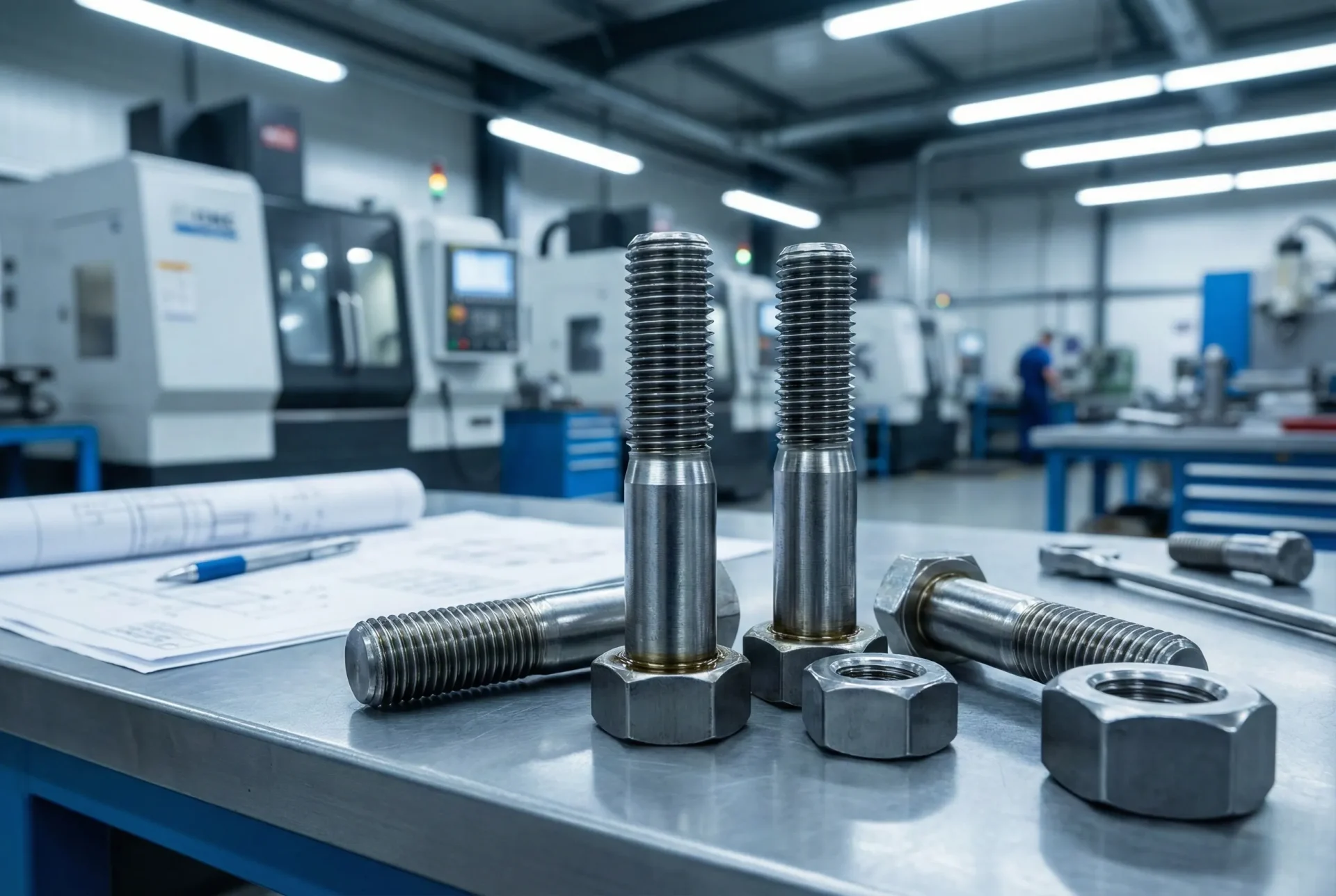
In manufacturing sites and plant designs, “Stud Bolts” are indispensable as unsung heroes. Unlike general hexagon bolts, this bolt has the unique shape of “having no head.” Why is it frequently used in flange connections for automotive engines and chemical plants?
In conclusion, the biggest reasons for adopting stud bolts are “protection of the base material’s threads” and “ease of repeated disassembly and assembly”. They demonstrate their true value especially in locations requiring frequent maintenance or when fastening with base materials of relatively lower strength, such as aluminum die-cast.
In this article, we will explain important points that procurement and technical personnel should know in 3 minutes, ranging from basic knowledge of stud bolts and how to read strength classes based on JIS standards, to procurement strategies in Vietnam which is a key card for cost reduction. We will also present hints to solve your company’s procurement challenges while incorporating the merits of local procurement provided by Ohta Vietnam.
A Stud Bolt refers to a “rod-shaped bolt threaded at both ends and having no head”. Generally, it takes a structure where one side is embedded into the base material (engine block or equipment body) and a nut is attached to the other side for tightening.
In JIS standards (Japanese Industrial Standards), it is classified as a “stud,” and broadly divided into the following types based on shape.
Due to this shape, stud bolts also serve as “positioning guides.” When installing heavy flanges or covers, by planting the stud bolts first, parts can be temporarily placed by passing them through the bolts, significantly improving work efficiency.
When compared to hexagon bolts, stud bolts have clear engineering merits.
There are various shapes of stud bolts to suit different applications.
In the automotive industry, they are frequently used for fastening exhaust manifolds and cylinder heads, requiring durability in high-temperature and high-vibration environments.
What determines bolt performance is the “strength class.” In the case of steel bolts, the grade is expressed numerically. For example, if there is a marking of “10.9”, it has the following meaning.
In other words, a “10.9” bolt indicates high performance where it breaks at 1000MPa and returns to its original state without permanent deformation up to 900MPa. Common strengths are “4.6” or “4.8”, but classes called High Tension Bolts (High Strength Bolts) such as “8.8”, “10.9”, and “12.9” are used for critical safety parts requiring high fastening force.
Calculating the length (L) is important in selecting stud bolts. In the case of double ends, the following factors are generally considered.
The overall length can be estimated using the following reference formula:
L = Thread Engagement Depth + Thickness of the Clamped Component + Nut Height + Thread Protrusion
Failure to select the appropriate length leads to fastening failure due to bottoming out or insufficient strength due to insufficient thread engagement.
The most common troubles in screw fastening are “loosening” and “breakage.” To prevent these, management of tightening torque (T) to generate appropriate axial force (F) is indispensable.
The basic formula is as follows.
T = K × d × F
For example, if you want to obtain a target axial force of 20,000N with an M10 bolt (d=0.01m), assuming a torque coefficient of 0.2,
T = 0,2 × 0,01 × 20.000 = 40 N·m
it becomes. At Ohta Vietnam, optimal product proposals based on such technical calculations are also possible.
The Vietnamese economy in 2024 is showing a strong recovery, with the real GDP growth rate reaching 7.1%. In the manufacturing industry, it is solidifying its position as the world’s factory as a top candidate for production transfer from China (China Plus One).
Particular attention should be paid to cost competitiveness. The minimum wage in Vietnam’s major cities (Hanoi/Ho Chi Minh) is about 29,000 yen per month, which is still a large labor cost difference compared to Japanese manufacturing sites. Leveraging this cost merit, by performing bolt manufacturing and inspection tasks involving labor-intensive processes in Vietnam, a total cost reduction of about **15% to 30%** can be expected in some cases.
Although some voices say, “Overseas procurement brings anxiety about quality,” the current supply chain in Vietnam has become sophisticated due to the expansion of Japanese companies.
Ohta Vietnam has established a management system of Japanese quality in this land of Vietnam.
Stud bolts are important fastening parts that influence the longevity and maintainability of machinery.
For their selection, “understanding “Strength Class (10.9 etc.)” based on JIS standards and appropriate “Tightening Torque Calculation”are essential.
Also, as cost competitiveness intensifies, procurement in Vietnam is a compelling option. With a vibrant market exceeding 7% growth rate and manufacturing costs cheaper than Japan, it is possible to stably procure high-quality parts.
Ohta Vietnam optimizes your company’s stud bolt procurement with reliable technical capabilities and networks in Vietnam. If you have challenges such as “no drawings,” “special standards,” or “want to lower costs,” please feel free to consult us. We will propose a concrete plan to update your procurement strategy.